Barangay Clearance for PNP: Requirements & Fees 2026
A barangay clearance is an important document required by most of the Filipinos for local jobs, business permits, and other legal matters at the local level. Long lines, unclear fees, and confusing requirements often waste your time. This guide walks through what it covers, what it costs, and how to get one without a second trip.
What Is a Barangay Clearance?
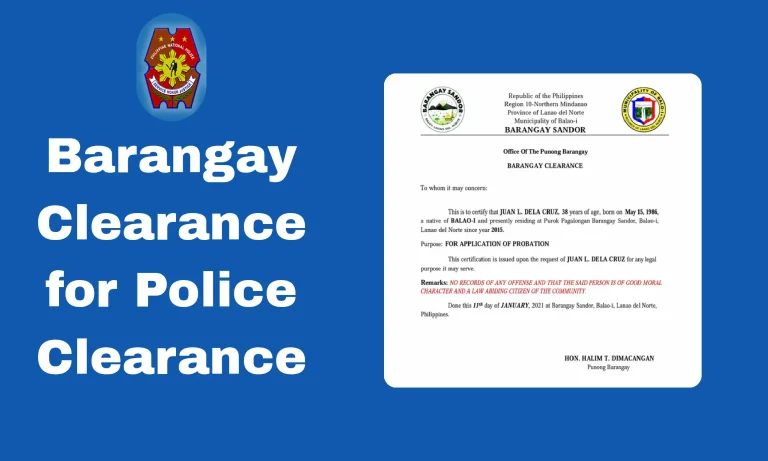
A barangay clearance is a certificate issued by your barangay hall. It confirms that you live in that barangay and have no criminal record within the community.
The barangay captain, or an authorized staff member, signs the certificate and stamps it with the official barangay seal. Without that seal, the document holds no weight at all.
What Is a Barangay Clearance Used For?
The most common uses are
- Employment, especially for jobs based within your own city or municipality
- Supporting document for an NBI or police clearance application, particularly under the first-time jobseeker waiver
- Business permits, since every barangay-based business needs this before applying for a mayor’s permit
- Bank account opening, where some banks accept it as a secondary ID or proof of address
- Postal ID applications, where it is one of the standard supporting documents
- Loan applications, since micro-lending institutions often use them to verify residency and character
Barangay Clearance Requirements
The requirements are simple, but missing even one of them means a second trip. As per the standard process followed by most barangay halls nationwide, you will need the following:
- One valid government-issued ID with your current address (PhilID, passport, driver’s license, UMID, or voter’s ID)
- A Community Tax Certificate, also called a cedula, for the current year
- Proof of residency, such as a recent utility bill or a lease contract, if your ID still shows an old address
- An accomplished application form, available at the barangay hall
- Payment for the clearance fee and the cedula
If you moved into your current barangay less than six months ago, some offices will also ask for a Certificate of Transfer or an endorsement letter from your previous barangay. Ask the desk officer in advance if this applies to you so you are not sent away to get it on a separate trip.
You can only request this certificate from the barangay where you actually live. A copy from a neighboring barangay will not be accepted, even if it is closer to your workplace.
Common Mistake: Many applicants assume any barangay near their workplace can issue their clearance. Only the barangay that covers your registered home address can do this. Bringing your documents to the wrong barangay hall wastes the whole trip.
Barangay Certificate for First-Time Job Seekers for Free Police Clearance
First-time job seekers will need a barangay certificate with the purpose mentioned as “1st-time job seeker.” If you get a regular brgy clearance, it will not be accepted at the police station to avail of free police clearance as a first-time job seeker under RA 11261.
- Go to your barangay hall during office hours (8:00 AM to 5:00 PM)
- Inform him you need a certificate as a first-time job seeker.
- Fill out the form and sign the Oath of Undertaking.
- Submit the form along with your valid ID, cedula, and proof of residency.
Note: There is no fee for a barangay certificate for FTJS in most of the barangays.
The barangay should have the dry seal and the signature of the barangay captain.
How much is the Barangay Clearance Fee?
The fee for personal use, such as employment, usually runs between ₱20 and ₱150. The exact amount depends on your city or municipality’s local ordinance.
On top of that fee, you will pay for a cedula. The cedula costs ₱5 as a base tax, plus ₱1 for every ₱1,000 you earned the previous year. Someone with no income for the year only pays the ₱5 base.
A business version of this certificate costs significantly more. Rates often run from ₱200 to over ₱1,000, depending on the size of the business.
First-time jobseekers do not pay at all. Under Republic Act No. 11261, the First-Time Jobseekers Assistance Act, you qualify for a free clearance. You only need to sign an Oath of Undertaking at the barangay hall.
Important Tip: Bring proof that you are a first-time jobseeker, such as your school ID, diploma, or transcript of records. The barangay will issue both your free clearance and a separate “First-Time Jobseeker Certificate.” Keep that second certificate, since you will use it again for a free NBI or police clearance application.
How to Get a Barangay Clearance
Most barangays in the Philippines still process this document on a walk-in basis. Here is the process most applicants will follow.
- Go to your barangay hall during office hours, ideally early in the day to avoid the lunch rush.
- Ask the desk officer for an application form.
- Fill out the form with accurate, current details.
- Submit the form along with your valid ID, cedula, and proof of residency.
- Pay the fees at the cashier window.
- Wait for the captain or an authorized staff member to sign and stamp your copy.
Before signing, the staff member typically checks the barangay logbook or blotter to confirm you have no pending complaint, such as a noise dispute or an unresolved neighbor conflict. If your record is clean, you get the clearance right away. If there is an unresolved dispute on file, some barangays hold the clearance until the matter is settled before the Lupon, the barangay’s own conflict-resolution panel.
Can I Apply for Barangay Clearance Online?
Most of the cities do not allow online requests for this document. However, some cities, including Makati, Taguig, and Quezon, have their local online portals for online services, including brgy clearance. In Quezon City, you can apply online through its QC i-Apply portal. Manila residents can check the Go Manila app, and Makati residents can check the Maka-Connect portal for similar online services. Most barangays across the country still remain walk-in only.
Where an online option exists, the steps are usually similar:
- Register an account on your city’s portal
- Upload a digital copy of your valid ID
- Fill out the e-form and select the clearance type
- Pay the fee online and save the receipt
- Claim your copy in person or through a delivery service
Check your city’s official website first, since availability still changes from one barangay to the next.
How Long Is It Valid?
This certificate is typically valid for six months to one year. The exact period depends on the issuing barangay and the purpose stated on the document.
Many barangays do not print an expiry date directly on the paper. When no date is shown, count from the date of issue instead.
Some receiving offices, such as banks or strict employers, only accept a recent copy. Check the requirement letter first, rather than assume the standard validity applies to your case.
Can I Get a Barangay ID at the Same Time?
Many applicants pick up a brgy clearance specifically to apply for a Barangay ID right after, since the same valid ID, cedula, and proof of residency you already brought also cover this request. A Barangay ID is useful if you do not yet hold any other government-issued ID, and it is commonly accepted for SIM registration and small transactions.
Simply tell the desk officer you want to upgrade your clearance application to include a Barangay ID. Expect to pay an extra fee, often around ₱50 to ₱100, and to wait briefly while your card is printed and laminated.
Note: A Barangay ID is a local-level ID, not a primary government ID. Major banks and national agencies usually still ask for a passport, driver’s license, UMID, or national ID alongside it.
Frequently Asked Questions
Conclusion
A barangay clearance is one of the simplest documents to get in the Philippines once you know what to bring. One valid ID, a current cedula, and proof of residency cover almost every applicant’s needs.
Go to the barangay hall that covers your actual home address, not the one nearest your office. If you are a first-time jobseeker, ask for the Oath of Undertaking so you can claim it for free.
You will likely need this certificate again for other documents down the line. Many employers also ask for a valid police clearance certificate alongside it, so prepare both at the same time.