Police Clearance Requirements Philippines Guide 2026
Police clearance requirements are simpler than most people think. Imagine a situation where you are in line at the police station, and when it is finally your turn, a document turns out to be missing. That single moment of frustration is exactly what this guide helps you avoid.
This guide covers all police clearance requirements, including what you need, what you do not need, and what changes depending on your situation. That includes fresh graduates, students, minors, and foreign nationals.

What Are the Police Clearance Requirements?
The police clearance requirements are simple. As per the official National Police Clearance System (NPCS) portal, every applicant brings three things to the station on appointment day.
- One valid government-issued ID
- Proof of payment or payment confirmation slip
- Reference number from your NPCS online appointment
That is the official minimum. Many people bring two IDs as a precaution. This is reasonable in case one ID has a minor issue, though the NPCS guide only requires one. First-time job seekers under RA 11261 need one extra document: a Barangay Certificate.
Valid IDs Accepted for Police Clearance (2026 List)
Your ID must be government-issued, valid, and show your full name, photo, and signature. The personal details on your ID must exactly match what you entered on the NPCS portal. A single spelling difference can cause delays at the counter.
Primary IDs (most widely accepted):
- Philippine Identification Card (PhilID / National ID)
- Philippine Passport (DFA-issued)
- LTO Driver’s License (including Student Permit in card format)
- SSS ID or Unified Multi-Purpose ID (UMID)
- GSIS eCard
- Professional Regulation Commission (PRC) License
- Voter’s ID or Voter’s Certification from COMELEC
- PhilHealth ID
- Postal ID (issued 2015 onwards)
- OWWA ID
- Senior Citizen ID
- Seaman’s Book
If you have any of these, you are covered. The PhilID is currently the easiest option, since the NPCS system links directly to the PhilSys database.
Secondary or supporting IDs (if needed):
- PSA-issued Birth Certificate (on SECPA security paper)
- TIN ID (BIR-issued card)
- NBI Clearance (must still be valid)
- Barangay Residence Certificate
- Marriage Certificate (for married women using a spouse’s surname)
Secondary IDs alone are generally not enough as your main identification. They work best as backup when your primary ID has a data mismatch or when the station asks for extra proof.
Do You Need Barangay Clearance or Cedula?
No. A barangay clearance and a community tax certificate, or cedula, are not required for the National Police Clearance application through NPCS.
This is one of the most common points of confusion. Some older local police clearance processes used to ask for these documents, but the centralized NPCS system does not require either one.
Common Mistake: Several websites list a barangay clearance and cedula as “sometimes required” for police clearance. This applies only to certain Local Police Clearance (LPC) transactions at the barangay level, not the National Police Clearance through NPCS. A barangay certificate is only needed if you are applying as a first-time jobseeker to claim the RA 11261 fee waiver
Free Police Clearance for First-Time Jobseekers: RA 11261
Under Republic Act No. 11261, the First-Time Jobseekers Assistance Act, Filipinos applying for their first job get a free National Police Clearance. This is a one-time privilege. All future applications need the standard fee.
To claim this waiver, you need one extra document beyond the regular requirements:
FTJS Barangay Certification, a certificate from your barangay confirming you are a first-time jobseeker and a resident of that barangay
When registering on the NPCS portal, tick the “First-Time Job Seeker” checkbox. This removes the ₱150 fee from your payment. On appointment day, present the original FTJS Barangay Certification along with your valid ID.
Important Tip: The FTJS Barangay Certification differs from a regular barangay clearance. At your barangay hall, specifically ask for the “First-Time Jobseeker Certification” under RA 11261, since not all staff know the term right away.
Police Clearance Requirements for Students, Minors, and Foreign Nationals
Students
Students applying for an internship, scholarship, or school enrollment follow the standard process and have to fulfill certain police clearance requirements. Your school ID paired with your registration form or enrollment certificate works as a valid ID combination. Some stations may also ask for a PSA birth certificate, particularly if your school ID is your only document.
If you are 18 or older, the regular adult process applies with no extra steps.
Minors (Under 18 Years Old)
Minors rarely need a police clearance. Some cases still call for one, such as adoption proceedings, scholarship programs, or specific travel documents. When that happens, bring the following in addition to the minor’s own ID:
- PSA-issued Birth Certificate
- Valid ID of the parent or legal guardian
- Notarized letter of consent from the parent or guardian
- The parent or guardian present in person at the station
Foreign Nationals
Foreign nationals residing or working in the Philippines can apply for a National Police Clearance by presenting:
- Valid foreign passport
- ACR I-Card (Alien Certificate of Registration Identity Card)
- Proof of address in the Philippines, such as a utility bill, lease contract, or barangay certificate
Some stations may also ask for a letter stating the purpose of your clearance. Calling your chosen station ahead of time is a practical step if you are a foreign applicant.
What You Do NOT Need to Bring
Skipping unnecessary paperwork saves you a trip to the barangay hall or a printing shop. Based on the current police clearance requirements, you do not need any of the following for a regular application:
- Barangay Clearance or Certificate of Residency, unless you are claiming the RA 11261 fee waiver
- Community Tax Certificate (Cedula)
- Photocopies of your ID, since the station verifies your original document directly
- A printed application form, since the entire application is completed online through the NPCS portal
Bringing these extra papers does not cause a problem, but none of them are required to receive your clearance.
A quick note on dress code: sleeveless shirts, shorts, and slippers are not accepted at most stations, since your photo is taken the same day. Business casual or smart casual clothing works at every station.
PNP vs. NBI Clearance: Which One Do You Need?
Most employers, government agencies, and institutions require the National Police Clearance, while embassies and employers abroad ask for NBI clearance. Knowing the difference saves you from the wrong process entirely.
| Feature | National Police Clearance | NBI Clearance |
|---|---|---|
| Issuing Authority | Philippine National Police (PNP) | National Bureau of Investigation (NBI) |
| Use | Legal matters, local transactions, local employment | Visa Applications, Immigration, Employment Abroad |
| Where to apply | PNP clearance portal, NPCS Android app, and police station | NBI clearance website and NBI branches |
| Application mode | Online appointment required | Online appointment required |
| Validity | 6 months | 12 months |
The DFA has also clarified that passport applications require the National Police Clearance. A local clearance is no longer accepted for this purpose.
Step-by-Step: How to Apply Using the NPCS Portal
Here is a focused summary of what happens from a police clearance requirements perspective.
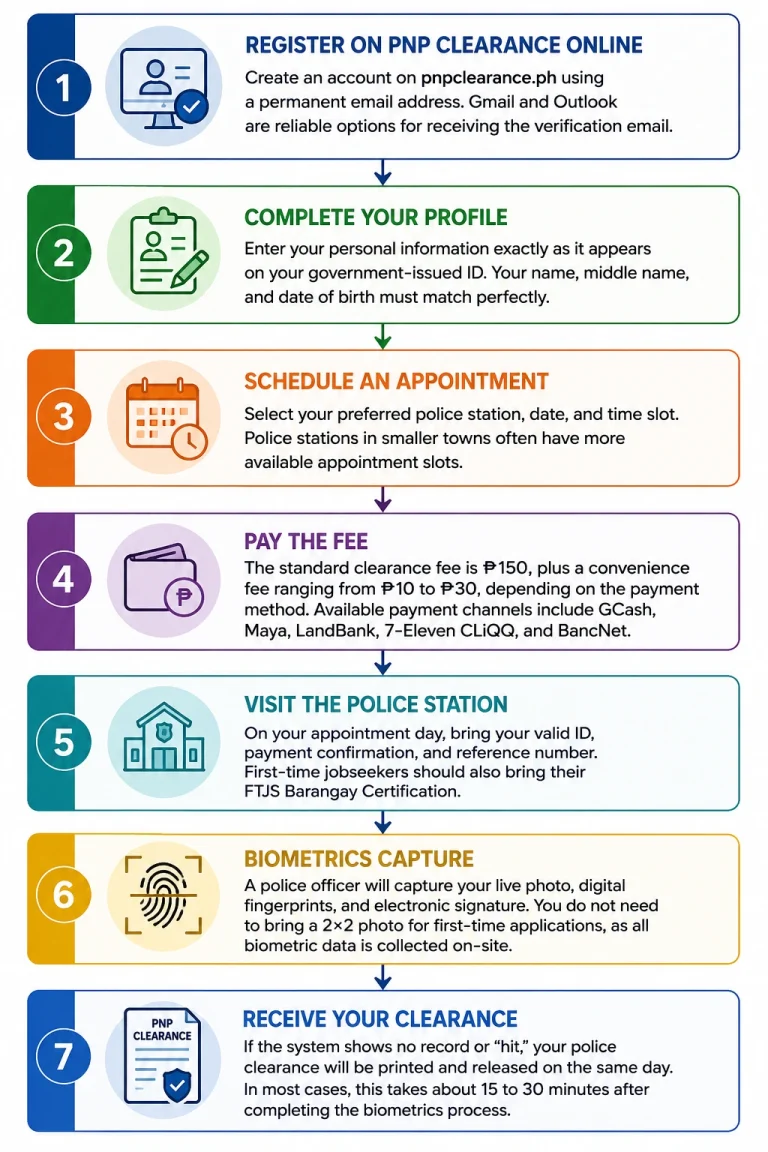
Step 1: Register on pnpclearance.ph
Create an account using a permanent email address. Gmail and Outlook work reliably for the verification email.
Step 2: Complete your profile
Enter your personal details exactly as they appear on your government ID. Name spelling, middle name, and birthdate must match perfectly.
Step 3: Set your appointment
Choose your preferred police station, date, and time slot. Stations in smaller towns tend to have more available slots.
Step 4: Pay the fee
The base clearance fee is ₱150, plus a convenience charge of ₱10 to ₱30 depending on your method. Payment channels include GCash, Maya, LandBank, 7-Eleven CLiQQ, and BancNet.
Step 5: Visit the station on your appointment day
Bring your valid ID, payment confirmation, and reference number. First-time jobseekers also bring their FTJS Barangay Certification.
Step 6: Biometrics capture
The officer takes your live photo, digital fingerprints, and electronic signature. You do not need a 2×2 photo for first-time applications, since everything is captured on-site.
Step 7: Receive your clearance
If the system returns a clean record, your clearance is printed and released the same day. This typically happens within 15 to 30 minutes of finishing biometrics.
For a detailed procedure, you can refer to our article on police clearance online application guide.
What Happens After Biometrics: HIT vs No HIT
Once your biometrics are taken, the NPCS checks your details against the national PNP database. There are two possible outcomes.
No HIT
It means the system found no matching record. Your clearance is printed and handed to you the same day. This is the outcome for most applicants.
HIT
“HIT” means the system found a name or data entry that matches someone with a criminal record or pending case. Getting a HIT does not mean you have a criminal record yourself. It most often happens when your name closely matches someone else already in the database.
How to deal with a HIT?
In a namesake HIT, your application goes on hold while a verification officer manually reviews the matched record. This process usually takes 5 to 12 working days, with no additional fee. You return after the review period to collect your clearance once the false match clears.
If the HIT turns out to be a genuine match tied to your own identity, you will need legal documentation first. A Court Order of Dismissal or a Certificate of Case Finality, and both work for this. Legal counsel is advisable in this situation.
Important Tip: Never apply for police clearance the day before you need it. Even a routine HIT verification adds at least a week to the timeline. Apply two to three weeks before your actual deadline.
Frequently Asked Questions
Conclusion
Police clearance requirements in the Philippines are simple once you know what to bring and what to skip. One valid government ID, your reference number, and your payment receipt cover the mandatory list. Everything else depends on your specific situation.
Skip the unnecessary trip to the barangay hall for documents that NPCS does not require. Just do not wait until the last minute, since a HIT verification period can delay your release by a week or more. Plan to apply two to three weeks before you actually need your clearance.
Once you have it in hand, you can verify your clearance status online using the QR code printed on the certificate.